A group of people participate in a coding workshop. A person wearing a black shirt with "code club" written on the back is seated in the foreground. Several laptops are on the table, with participants engaging in programming activities. White digital icons, including lightbulbs, graphs, and a globe, decorate the image

Check out these updates to the Code Club platform

We’ve introduced new features to help club leaders manage events, track attendance, and communicate more effectively. These updates make running your club easier, so you can focus on supporting young creators.

A group of people participate in a coding workshop. A person wearing a black shirt with "code club" written on the back is seated in the foreground. Several laptops are on the table, with participants engaging in programming activities. White digital icons, including lightbulbs, graphs, and a globe, decorate the image.
We’ve made running your Code Club even easier

Easily check in and check out creators

Club leaders can now use the platform to check creators in and out as they arrive and leave events. This feature helps you keep track of attendance in real-time to help you organise larger groups and keep everyone attending safe if there is a fire alarm. After an event, you can also look back and see who attended and who didn’t.

New search and filter options

Managing larger groups of attendees is now easier with the search and filter feature. You can quickly find specific creators and filter by status. The three groups you can filter by are:

  • Not arrived – Creators who haven’t arrived.
  • Checked in – Creators currently at the event.
  • Checked out – Creators who have left.

Email attendees who booked tickets

Need to send a reminder or communicate a change to the event? You can message all attendees who have booked tickets to an upcoming event directly from the Code Club platform. Whether you want to share changes to event details or provide information on resources in advance, it’s now quick and hassle-free. You can even use markdown to format your message.

Special assistance flag

When booking into an event, parents/carers can share any special assistance a creator might need to join the event or access the venue. In the ‘manage attendees’ section, you will see any needs they might have under the creator’s name as a flag icon with the word ‘Assistance’ beside it. To see more details, click on the name of the young person and the type of assistance they require will be visible.

A user interface card displaying information about Jill Hill, age 12. It includes two selectable options: "Work on my own project" and "Assistance," with the latter highlighted. In the top right corner, there are three buttons: a cross (X), a checkmark (✔) highlighted in green, and an arrow pointing right.
Special assistance flag feature

Find resources you need quicker

We’ve reorganised the resources section on our website to make it easier for you to find the resources you need. Whether you’re looking for activities, certificates, or resources for planning an upcoming session, everything is now structured to make it more accessible.

A webpage from Code Club featuring a "Resources" section with a green banner that reads, "Our resources are designed to help you start, manage, and grow your club." Below, a "Browse by category" section displays three colorful icons: a green box with code brackets and a cursor, a pink box with a lightbulb, and a blue box with a magnifying glass over a person icon.
Resources on the Code Club website

Expanding language options

The Code Club website, including our platform features, is available in five languages. These are Dutch, English, French, Japanese and Welsh. We will soon be adding resources in these languages as well as Greek translations to further support our global community. A huge thank you to our volunteer community of translators who share their skills to make Code Club accessible to more young people around the world!

Thank you to our volunteer community of translators

These updates are designed to help you manage your club more efficiently, so mentors can focus on providing a great experience to creators.

Log in now and explore these new features! If you have any feedback about the platform or website, please email support@codeclub.org.

Code Club and International Mother Language Day: Embracing diversity

Depending on our culture, beliefs, and interests, February can mean different things for each of us — Lunar New Year, Valentine’s Day, World Nutella Day… the list goes on. On 21 February, there is a day related to everyone: International Mother Language Day.

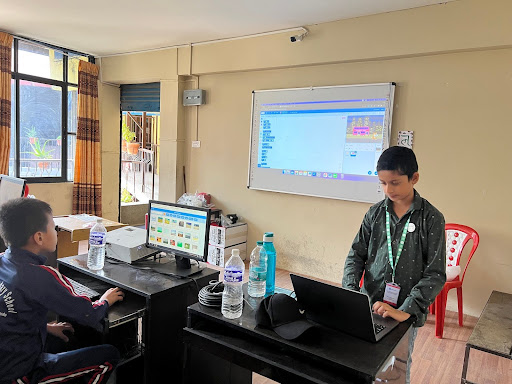
A room with a two boys looking at computer screens.
Young coders in Nepal

Celebrating linguistic diversity

International Mother Language Day celebrates the diversity of languages and cultural identities across the world. At Code Club, we also share a common vision: to give children the opportunity to learn to code, no matter who they are or where they come from.

Did you know?

  1. There are more than 7000 known languages in the world
  2. English is the most widely spoken language globally (approximately 1.45 billion people)
  3. The most widely spoken first language is Mandarin (Standard Chinese) (approximately 940 million people)

I’m Lewis, the Code Club Global Partnerships Manager. Although I’ve primarily lived, learned, and worked in a monolingual environment, where English is the most widely spoken language, I learned a lot about linguistic diversity when I spent time in India. When visiting ancient monuments just outside of Chennai with a friend from New Delhi, I asked if he could translate what our guide was describing, however, my friend shrugged his shoulders and said, “I would love to, but we speak two different languages.” I was fascinated to learn that India has 22 official languages from a total of 121, and 270 ‘mother tongues’.

A man standing in front of the Mahabalipuram
Lewis in Mahabalipuram, India

A global clubs community

At the Raspberry Pi Foundation, we have 52 Global Clubs Partners in 41 countries, each with their own networks of clubs involving thousands of young people and volunteers communicating in lots of languages. We recognise the importance of giving young people opportunities to learn in their first language and so we translate as many of our coding resources as we can.

We are committed to creating inclusive learning experiences for young people, and this commitment is shared by all our partners, who actively work to ensure that everyone feels welcomed and valued. Kaye North, Community and Engagement Manager at Code Club Australia, shares how they celebrate cultural and linguistic diversity through coding projects:

“Australia is a multicultural country that respects and values the diversity of its people. Our First Nations communities are recognised as the oldest living culture in the world and today speak a total of 120 different dialects, and of the 26 million strong population, over 270 different ancestries are recognised… Our co-developed projects, such as Tagai Constellation, support communities to share their mother language with a wider community, and also provide a framework for how each individual community can share their language through code.”

Kaye North, Community and Engagement Manager at Code Club Australia

Digital Future Aotearoa (DFA), a long-standing partner in New Zealand, has been working alongside Ōtautahi kura (kura are state schools where the teaching is in te reo Māori and is based on Māori culture and values) to introduce resources with a special focus on Matariki. Learn more about their latest work in this area:

“In kura this year there has been a strong commitment to learn more about Matariki and to celebrate, reflect, and grow knowledge. It has been amazing to support kura aspirations through DFA’s outreach mahi alongside Te Pā o Rākaihautū, Beckenham Te Kura o Pūroto, and Aidanfield Christian School.”

– Kate, Facilitator at Digital Future Aotearoa

How you can help

At the Raspberry Pi Foundation, we make our free online learning resources on the projects site available to everyone, everywhere, so more young people have the opportunity to explore coding and digital making, wherever they are in the world. Thanks to dedicated translation volunteers, we’ve published over 1700 project translations in more than 30 languages, making our online learning experiences more accessible to young learners worldwide.

“IT is everywhere and becomes more important every day. That’s why it’s good to have the opportunity to learn about it while you’re still young. And therefore, I support the Raspberry Pi Foundation by translating their courses into my mother language, which is Dutch. Because you really can’t expect a 9-year-old to fully understand something when it’s filled with foreign words. As a side effect, I’m learning a lot myself while doing this. So, I consider this a win-win situation.” 

– Jeroen Wernsen, Raspberry Pi Foundation volunteer translator

Being a volunteer translator is highly rewarding. It also helps you to develop lots of different skills and gain new knowledge around translation, localisation, and programming.

If you would like to find out more about translation at the Raspberry Pi Foundation or you would like to contribute to the translation of our learning materials, visit rpf.io/translate or contact us at translation@raspberrypi.org.