Mentor voices: Chris on empowering independent coders in Minnesota

We’re sharing insights from the incredible mentors who guide and inspire young coders. It’s their unique perspectives and the positive learning environments they foster that truly make these clubs thrive and help our global community grow.

Meet Chris, a passionate mentor involved with Normandale Hills Code Club in Bloomington, Minnesota, who’s building an environment where coders develop their problem-solving skills, normalise failure, and explore their creativity.

A smiling mentor named Chris from the Normandale Hills Code Club in Minnesota, promoting a positive learning environment for young coders.

Let’s kick things off by asking:

What inspired you to become a Code Club mentor?

Volunteering gave me a great excuse to lean into my computer engineering background and do something fun with my kids, who are fifth and third graders. It’s been a blast helping them and all the other kids learn more about computer science while bringing in some real-world perspectives and industry terms (like rubber duck debugging and pair programming).

What makes Code Club projects engaging for the young people in your club?

Our club did a number of simple projects to start using the micro:bits — things like creating a name badge, making pedometers, and playing the ‘Hot Potato’ game — but what really brought out the imagination and creativity of the kids was challenging them to design a game of their own.  

We brought in real-world concepts like project briefs to get them to think critically about what they wanted to build and how they wanted to approach it. Ideas ranged from simplified versions of FIFA and Madden to variations of existing party games.  

There were several moments where you could see it visibly click for one of the kids — when they realised they were not constrained by the step-by-step tutorial into building a specific thing, but had the freedom to create whatever they could dream up… which was quickly followed up by the slight fear in realising the challenge they were in for!

An illustration of a micro:bit surrounded by colorful graphics, including musical notes, party hats, and hearts against an orange background, symbolizing creativity in coding.
Engage young people in physical computing with Code Club projects that explore the BBC micro:bit

How are Code Club projects helping to ignite excitement, creativity, or lively discussion with creators?

It’s fun to see how all the different projects inspire certain kids — some have been more excited by the more visual projects, while others get joy from customising and making a project their own. 

When they were given their first option to build something of their own design, there were LOTS of questions. They ranged from trying to understand the guardrails to questioning how they were ever going to know how to code it.  

Our challenge to them was to just get started! We encouraged the kids to start writing code and test it when it was small, then write a little more and test it a little more. The emphasis was on letting the code come together iteratively, and tackling challenges as they came up instead of trying to anticipate all of them ahead of time.

What impact do you believe Code Club projects have on creators’ understanding of coding concepts?

One of the biggest benefits I see is normalising failure — even if following a tutorial, most kids make at least one mistake the first time doing a coding project. And that’s okay!  

Debugging code is a normal part of the development process, and that makes it safer for the creators to experiment, mess up, and learn along the way. My hope is that the willingness to try (and sometimes fail!) will extend into other parts of their lives and inspire them to take more risks than they may have otherwise.

How does your Code Club empower young coders to develop a sense of independence?

As the club has gone on, our young people have been given projects with less and less guidance, moving on from step-by-step tutorials to projects where they define their own problems. 

We frequently talk about the creative side of coding — how you, the coder, get to decide how to solve a problem. Your code may not look exactly like your neighbour’s. There is no one ‘right’ answer. Giving the kids the freedom to solve the problem in their own way builds a deeper sense of ownership of the solution than having everyone learning to do things exactly the same.  

We also give kids the opportunity to pair and partner with others, and put their collective brainpower to work on tackling a problem. This helps them learn alternative perspectives and broadens their understanding.

Has Chris’ story inspired you to make an impact? Join our community of passionate mentors! With active Code Clubs in over 100 countries, there’s a place for you. Ready to get started? Check out our Mentor at a Code Club page.

Micro-interview with Code Club alumni, Oliver

In our micro-interview blog series, we’re chatting to educators and young coding enthusiasts to hear about their Code Club experience.

When we received a message from 17-year-old Oliver, asking about the possibility of obtaining a Code Club lanyard to serve as a reminder of his experiences at Code Club, we knew we needed to find out more!

So we asked Oliver to tell us about his time at a Code Club in Dursley Library, Gloucestershire, which fueled his passion for computer science, leading him to study it at both GCSE and A level. Here’s what he said…

What inspired you to join Code Club?

I’ve always been fascinated by computers, but my primary school (like many) had a very limited ICT offering. I wanted to take a step on from Scratch, so joining Code Club was a natural choice for me!

So, when I was 8, I attended Code Club at Dursley Library. Among the local clubs my mum discovered, Code Club was by far the best — the resources were really well planned and helped to build up your coding skills.

How did participating in Code Club influence your interest in computer science?

Code Club at Dursley Library shaped my interest in computer science. The engaging activities and the guidance of the sixth formers running the club fuelled my passion for the subject. Every week we learnt a new skill and combined it all into a short Python game. The sessions were really fun, and I still sit down some weekends and just play around with Python!

What skills did you gain from Code Club that benefit your current studies?

The experience of coding helped, as coming into secondary school I already had some knowledge of Python. As well as this, I built a small Python script that colour-codes my virtual timetable, which I still find incredibly helpful!

Away from computer science, my existing knowledge of Python helped enormously when learning algebra, as I could apply my understanding of variables to maths! Don’t all laugh at once!

How has Code Club influenced your career direction?

I think Code Club had a huge impact! As soon as I joined my secondary school, I knew that I enjoyed programming and that I wanted to study computer science for GCSE. I attended activities, went to workshops, and even managed to go on a school trip to Silicon Valley. All of this got me excited for the future, and my experiences in Code Club played a pivotal role in shaping my career direction and is a key factor in why I now study computer science for A level.

What makes Code Club a great space for learners to explore computer science?

In my experience, the groups in Code Club have always been small, so there’s loads of time to play around and try new things. One of the key things I took away from it was that it’s OK to play around and get things wrong.

What advice would you give to other children thinking of joining a Code Club?

Go for it! It’s a fantastic opportunity to explore your interest in computers and learn in a fun and engaging way. It can be challenging, but once you get started, there’s nothing more satisfying than having your ideas appear on the screen before you!

Thank you, Oliver, for sharing your experience with us. And yes, we sent him a lanyard!

If you enjoyed this micro-interview, check out our micro-interview with young coder Terrell (9) and learn more about his experiences.

You don’t need any coding experience to run a Code Club, and you can help more young people like Oliver learn vital coding and digital skills for the future. Start a club today!

From Nepal to Uganda and beyond: our global Code Club network

At Code Club, it’s our mission to put a club in every community in the world. Ellie Proffitt, our Global Partnerships Manager, shares more on how we work with like-minded organisations around the globe to help make this goal a reality.

Two people hold the Code Club sign outside of a building
Growth Partner, Generación Tec

How can we help every child around the world access the fantastic opportunity of being in a Code Club? This is a question we think a lot about. Ensuring all children have access to digital making is a global challenge, and we want to be leading the way to find a solution.

We have Code Club colleagues based in the UK, Ireland, India and the United States, but unfortunately, we haven’t figured out a way to clone ourselves so that we can be based in every country in the world — yet!

This is why our partnerships with other organisations are so vital to our mission. We team up with others to help us grow our Code Club community in locations that we would otherwise struggle to reach. Thanks to the work of our partners, there are Code Clubs in rural villages in Malawi, isolated parts of Northern Canada, First Nations communities in Australia, and in thousands of villages, towns, and cities in between.

A map of the world highlighting where partners are
Where are partners are in the world

Our partnership programme

Organisations join our global partner network to work with Code Club and grow our club community in their local area, or even across their entire country. Our partners share our vision to give every child the skills, confidence, and opportunity to change their world, and are committed to helping us achieve this.

In return, we provide them with our free, high-quality resources, including online training, community events, and easy-to-follow projects to support them in their coding journey. We also translate our projects into various languages, so that more people around the world can use them and children get to experience coding without a language barrier.
For many partners, running a Code Club gives them an opportunity to learn to code alongside their young people.

From Kathmandu to Kampala

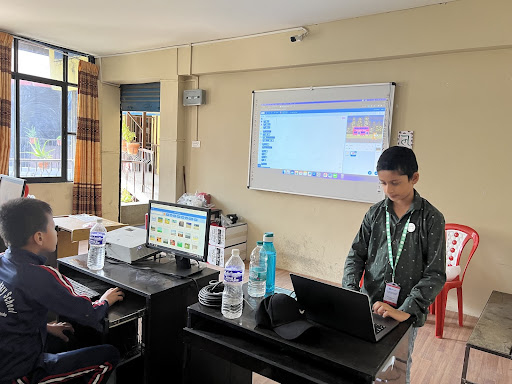
The organisation Digital & Beyond was already working with schools and educators in Kathmandu, Nepal, to support them with digital literacy. They joined our global partner network as a way to provide more children with the opportunity to learn to code, as most students were not receiving any kind of formal computing education. With support from Code Club, they have been able to set up over 15 clubs in the past 4 months!

A young coder standing at the front of a classroom sharing his project.
A Code Club member from Nepal shares his project

We applied to partner with Code Club because of our passion for education and wanting to contribute to teaching valuable skills to children, enhance their critical thinking skills, and create a culture of working in teams to solve real-world problems.
To expand the Code Club initiative beyond a single location, the partner network provides guidance and support for scaling up our efforts to reach more students in Nepal.

Sagun Dhungana, CEO of Digital & Beyond

For Silver Bolt, a partner based in Kampala, Uganda, Code Club fits perfectly with their own mission to break down the barriers to computing education. As well as supporting students in schools, Silver Bolt have been working alongside other organisations in their community to encourage more girls to get into computing.

So far, the Code Club partner programme has ignited a passion for coding and technology among young learners in Uganda, opening doors to a world of possibilities.

We recently trained a community-based organisation that empowers underprivileged girls with practical skills. By adding coding to their curriculum, we’ve opened up new horizons for these young learners. Our collaboration with Code Club not only aligns perfectly with our mission but also supplements it by enabling bridging of the digital divides and empowering underprivileged communities.

Maryanne Karamagi, Co-Founder and Managing Director of Silver Bolt

These are just two examples of how our global partnerships are bringing Code Clubs to young people around the world. If you want to see more examples, check out this micro-interview from Solomon and find out why Code Club is forming an essential part of young people’s learning journey in The Gambia.

Could you become a Code Club partner?

Our global partner programme is now open to applications from organisations around the world! If you are part of an organisation that shares our vision and values, and has the ambition and capacity to grow Code Club in your local communities, find out how you can get involved