The coding projects that empowered creators in 2025

Code Clubs are unique learning communities where young people get hands-on experience with a wide range of tools, from drag-and-drop Scratch blocks to text-based Python, from micro:bit to emerging AI tools.

It’s no surprise that in 2025 the biggest hits were the projects that build key skills and give creators a solid foundation to grow from, all while sparking curiosity, boosting confidence, and supporting steady progression — let’s explore the projects you enjoyed most last year!

A young girl and an adult man smiling and working together at a laptop, with the text 'Make your ideas' displayed above them.

Scratch: Building foundations through play

For many creators joining Code Club, the journey begins with Scratch. Here, they learn the building blocks of programming. 

The top three Scratch projects that inspired young coders in 2025 were

  1. Boat race – Steer your boat to the island and avoid the obstacles
  2. Space talk – Code a space scene with characters that emote
  3. Catch the bus – Create an animation with sprites that run or fly to catch a bus

These projects are quick to start, easy to personalise, and full of opportunities for added challenges. Creators build skills in sequencing events, switching costumes to simulate movement, and synchronising actions to tell simple stories — all core storytelling and animation techniques in Scratch.

A child in a green sweater interacts with a large screen displaying a coding interface, likely for a game or animation project. Various coding blocks and character animations can be seen on the screen.

Python: Turning ideas into real-world programs

As young people grow in confidence, many are keen to try text-based coding to express more complex ideas.

The top three Python projects that inspired young coders in 2025 were

  1. Astro Pi: Mission Zero – Have your code run onboard the ISS
  2. Hello world – Write an interactive project that uses emojis
  3. About me – Write a program telling people all about you

Each of these projects builds confidence by showing creators that they can write code, that their work can have real-world impact and simple scripts can express personal creativity.

A young boy using a computer mouse while focused on the screen, with an adult man seated beside him, in a room with other people working on computers.

BBC micro:bit: Making code tangible

Nothing builds confidence like making something physical work, like buzzers, lights or sensors. We all love to see that “aha!” moment in a Code Club session!

The top three micro:bit projects that inspired young coders in 2025 were

  1. Music player – Create a mood-matching tune picker
  2. Sound level meter –Track and log sound levels, with an alarm for high noise!
  3. Fortune teller – Use your micro:bit to read the future!

These projects are valuable because they combine instant physical feedback, real-world relevance, and opportunities for tinkering and customisation.
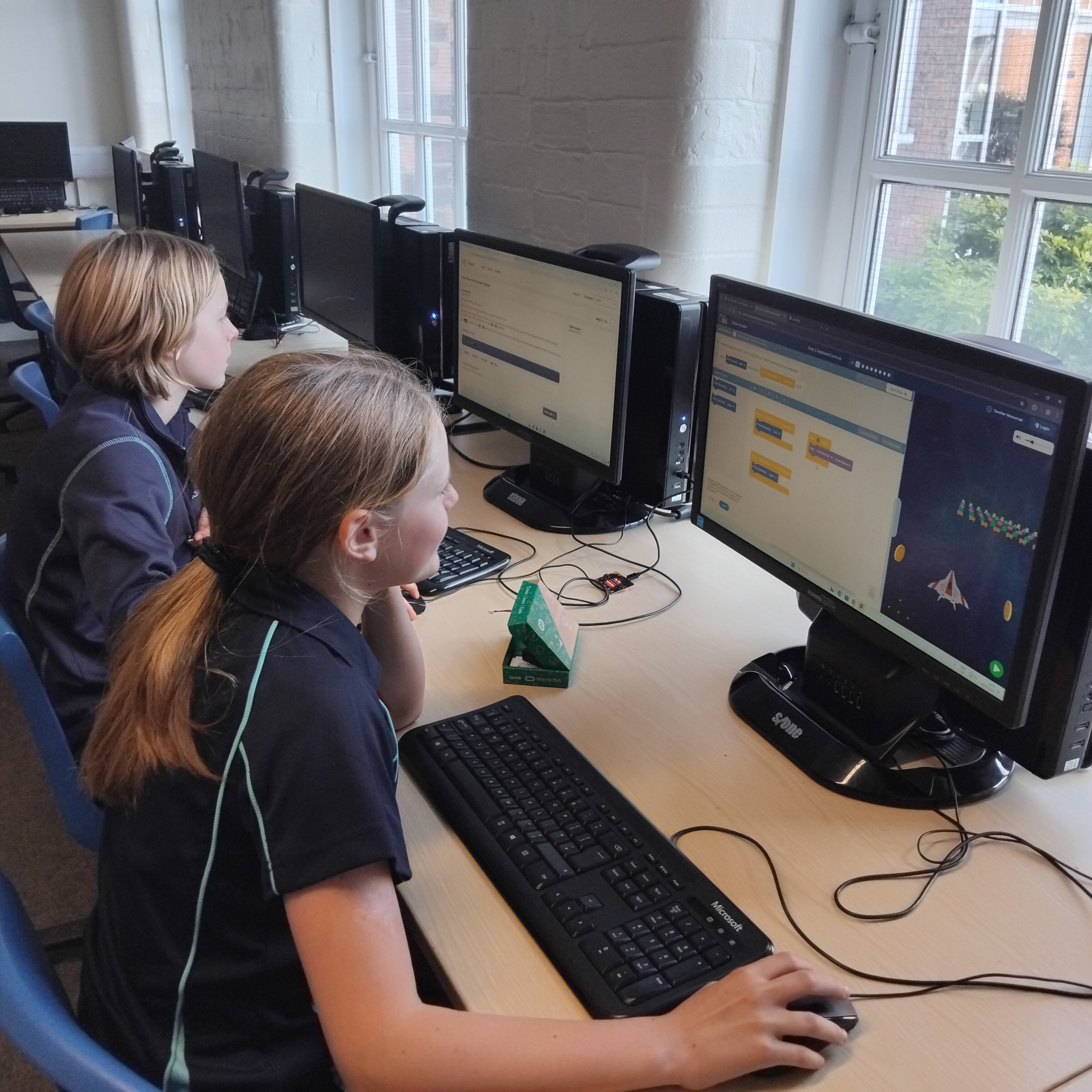
Two children sitting at computer desks, engaged in programming or gaming activities on their screens in a classroom setting.

AI projects: Empowering creators to shape the future

In 2025, many Code Club members became curious about artificial intelligence (AI). By introducing AI safely and accessibly, we help young people see themselves not as consumers of technology, but as creators who can shape how modern tools work.

The top three AI projects that inspired young coders in 2025 were

  1. Chomp the cheese – Make a mouth-powered, cheese-chomping game. Silliness for everyone!
  2. Doodle detector – Train a machine learning model to recognise your drawing
  3. Run an AI image generator on a Raspberry PiAn introduction to the world of AI image generation

These projects are powerful because they combine playful creativity and hands-on experimentation.
Two girls holding large green signs that read 'Be Cool' and 'code club', smiling at the camera in a creative workspace.

Code Club as a launchpad

From Scratch animations to Python adventures, from micro:bit inventions to AI explorations, 2025’s most popular projects show us that young people are keen to create, experiment, and express themselves.

As we look ahead to 2026, Code Club remains a launchpad for confident creators… and the best is yet to come!

Explore the rest of our projects and help creators spark their next big idea at Code Club.

Mvelo Hive Trust: Building confidence in young coders through Code Club

Mvelo Hive Trust, a global Code Club Partner, is a non-profit organisation whose mission is to enable marginalised groups and communities in Zimbabwe to gain access to education, technology, and skills through activities like Code Club.

Three young girls engaged in a coding activity, focused on a laptop with Code Club stickers, in a classroom setting.

Ruhee Shah, Global Partnerships Coordinator at the Raspberry Pi Foundation spoke to Blessed Moyo, Co-founder and CEO of Mvelo Hive Trust about their work and how Code Club inspires confidence in young creators.

From inspiration to a network of Code Clubs

Inspired by Africa Code Week, a digital literacy programme set up in 2015 to empower young people across the continent with essential coding and digital skills, Mvelo Hive Trust wanted to provide regular digital skills training, by offering consistent sessions through a network of Code Clubs. Their experience at Africa Code Week highlighted a significant gap: students in low-income communities lacked consistent, hands-on exposure to programming and collaborative problem-solving. There was no local space for them to regularly explore coding, troubleshoot, and develop projects. They noticed that many young students, despite their enthusiasm for creating games with Scratch, had little access to even basic coding tutorials.

“We wanted to equip learners with resources and digital skills that went beyond just learning how to code using Scratch, we wanted to provide lifelong learning in STEM and inspire the next generation to take up skills in coding.”
– Blessed Moyo, Co-founder and CEO at Mvelo Hive Trust

An insight into Code Club sessions

Since setting up their first Code Club only a year ago, Mvelo Hive Trust now reaches an incredible 350 learners each week in 8 different schools. Each session hosts young people aged 9 to 12 and is usually attended by educators who teach computing and digital learning. Blessed says the atmosphere is always energetic and supportive, as they focus on peer mentoring. They typically draw on resources from the Raspberry Pi Foundation and Code Club projects websites. The projects they use vary, including the introduction to Scratch projects ‘Space talk’ and ‘I made you a book’. Some clubs have begun to use more advanced Scratch projects like ‘Broadcasting spells’ and ‘Don’t fall in’.

A group of young learners holding up Scratch coding certificates outdoors, smiling and celebrating their achievements.

Building confidence in young coders

Blessed believes creating a supportive environment helps young creators grow the confidence to continue building and experimenting. In their first session, creators begin with a simple, guided project like ‘Space talk’, which allows them to see their ideas come to life. By dragging their first blocks and creating a basic animation, students gain an immediate sense of accomplishment and self-belief.

“A student, Sthandekile Ncube from Baines Jr Code Club, arrived [to her first code club session] shy and hesitant. By the end of that hour, she’d animated a bouncing ball and helped a classmate debug their code. Weeks later, she volunteered to demonstrate her project to the entire club.”

Regular celebrations are also incredibly important in making sure young coders build their confidence. By giving out monthly certificates to recognise milestones, or ‘high-five’ walls to encourage peer-to-peer praise, the focus shifts from perfection to progress.

“At one celebration, Joelle Steblecki from Moray Code Club, received applause for her problem-solving champion certificate. Her beaming smile was contagious — she told us she finally felt ‘like I belong in tech’.”
– Blessed Moyo, Co-founder and CEO at Mvelo Hive Trust

A classroom setting with young students sitting in front of computers, engaged in coding activities using Scratch.

Beyond Code Club

For the young people leaving Code Clubs, Blessed hopes that they carry with them a curiosity for lifelong learning, a capacity for creative problem-solving, and the confidence to experiment and “fail forward”.
Joelle Steblecki and Elton Muyambo, both from the Moray Code Club in Bulawayo, have already shown this. They represented their school at a tech competition with over 10 primary schools in Bulawayo, where their AI project earned them fourth place. Their success, and that of other young creators, shows that Code Club is a great foundation for future innovators, helping them explore potential careers in STEM.

What’s next for Mvelo Hive Trust?

With support from the city’s Mayor, Mvelo Hive Trust is actively working to expand its reach by establishing Code Clubs in the 29 schools managed by the Bulawayo City Council. They are also approaching local telecommunications companies to secure corporate partnerships and local funding, aiming to implement the Code Club programme across more schools.

Want to run your own Code Club? Find out more on how to get started.

People gathered in a group holding Code Club signs.

Fundació Bofill: Creating inclusive Code Clubs across Catalonia

Fundació Bofill is a non-profit organisation dedicated to fostering equity through education. They partner with Code Club to promote digital skills to young learners across Catalonia (an autonomous community in Spain) who might otherwise miss out.

Ellie Proffitt, Global Partnerships Manager at the Raspberry Pi Foundation, recently chatted to Ana Holschuh Heras, Code Club Community & Research Coordinator at Fundació Bofill, to learn more about how Fundació Bofill’s Code Club network in Catalonia has grown. Read on to learn what Ellie discovered.

People gathered in a group holding Code Club signs.
The team at Fundació Bofill

Why Code Club matters

In Catalonia, only 5% of the extracurricular activities that children participate in are technology-related. What’s more, due to financial barriers, 34% of children from low-income families do not participate in any extracurricular activities, which sharply limits their access to learning opportunities.

Fundació Bofill is determined to change this. Code Club stood out to them as a brilliant way to drive such change with its free, accessible projects in a format that would suit young learners. It seemed the perfect fit — not only to bridge the digital skills gap, but also to build a community in which young people would feel empowered to shift from passive consumers of technology to active creators.

“We believe every child has the right to learn programming creatively, giving shape to their imagination.” — Claudia Iannicelli, Code Club Regional Coordinator

A glimpse into Catalonian Code Clubs

Ana and her team chose to set up their clubs in schools and communities in under-resourced neighbourhoods where access to afterschool clubs is often limited.

Fundacio Bofill now supports an incredible 110 Code Clubs across 21 municipalities. That’s over 1,518 children who are benefiting from the opportunity to learn to code, who may otherwise have been excluded. 

Three young people sat in a row looking at laptops.
Creators attending a Code Club led by Fundació Bofill

A typical club session begins with a warm welcome and a recap of the day, followed by unplugged activities that spark critical discussions on technology and its many uses. Learners then dive into programming challenges, often working in pairs, to develop their problem-solving and coding skills. Reflections and previews of upcoming activities close the session.

“We help each other and learn as a team because I think without teamwork, you can’t work well.” — Code Club participant

Fundació Bofill’s clubs run in 16-week blocks, with four distinct phases: 

  • Building a Code Club community
  • Exploring programming concepts
  • Engaging in collaborative projects
  • Having a community showcase finale

The community showcase finale is an exciting highlight for everyone. Club members show their coding projects to their families and their wider school community, with attendees also getting to learn about Scratch and programming — often for the first time. It’s a wonderful example of how Code Clubs bring people together, and can inspire everyone to engage with technology in some way.

Representation for the next generation 

At the heart of Fundació Bofill’s Code Clubs is a dedicated team of 21 club mentors, who the organisation calls ‘dinamitzadores’. Leaders like these play a pivotal role in creating safe, engaging, and inclusive learning environments where all children feel empowered to explore and innovate. 

A group of people sat and standing holding Code Club branded cushions and signs.
Code Club leaders at a training event in Catalonia 

Nearly 90% of the dinamitzadores are young women aged 20 to 30. Representation matters — 47.5% of club attendees are girls — and having female leaders in technology is a powerful way to inspire girls to see themselves in tech roles. 

“The key role of a leader is to guide rather than teach, allowing children the freedom to develop their own projects and learn from the process and mistakes.” — Marta Salvador, Code Club leader

“When you make a mistake, it’s not a failure — it’s an opportunity to improve.” — Claudia Iannicelli, Code Club Regional Coordinator 

What’s next?

Fundació Bofill achieved so much in 2024. What’s in store for 2025? 

They have three clear aims: 

  • Increase the number of active clubs and participants
  • Ensure long-term sustainability by embedding Code Club into local educational policies
  • Continue to empower children, especially girls, to see themselves as future leaders in technology

A big congratulations to Ana and all those at Fundació Bofill for their work so far. We can’t wait to see Code Club grow even further across Catalonia!

Find out more about our Global Clubs Partnership network and how you can get involved.