Micro-interview with Code Club educator Ashwani Tiwari

In our new micro-interview blog series, we chat to educators and young coding enthusiasts about their Code Club experience. Enjoy!

Ashwani Tiwari runs “Maker Lab”, a network of Code Clubs in Udaipur, Rajasthan, India. 

Maker Lab was established in 2022 and partners with government schools in remote tribal areas to create maker labs for coding and tinkering. This network of clubs meets twice a week for one hour, with 1600 students (1200 girls and 400 boys) participating across 12 schools. 

Ashwani Tawari

What inspired you to start a Code Club network across Rajasthan?

I see Code Club as an opportunity to empower young girls who have limited access to technology and are at risk of being forced into early marriage. Code Club enables girls to co-create an excellent career path after schooling.

Can you give me an example of how girls are benefiting from being in your Code Club?

Yes! Harshita, an 11th grader, crafted an automatic river cleaning boat using a text-based coding language, Scratch, and a Raspberry Pi. She showcases how creativity and technology can come together to solve real-world challenges.

Her innovation earned her local acclaim, and secured her seed funding and a pivotal delay in her marriage. Enrolled as the first girl in her village to study science, she symbolises empowerment and the transformative power of education.

In what other ways does participating in a Code Club benefit young people’s future opportunities?

Coding isn’t just about opportunities; it’s a vehicle for empowering young people with problem-solving skills, computational thinking, and entrepreneurial talents. It opens multiple pathways, nurturing creativity and adaptability, preparing them for success in a rapidly evolving digital world, and using technology to change how we learn. 

Six girls behind a table, on the table are flyers and a laptop. Above the table on a washing line are posters.
Young coders from Maker Lab

Why do young people in Rajasthan find Code Club appealing? 

Young people’s attraction to adventure often sparks their interest in coding, as they see it as a tool to solve challenges and pursue careers in aspirational fields like STEM.

Code Club networks offer a sense of belonging and recognition for young coders. Members feel a unique identity and a deeper connection to the coding community. Achieving milestones, like 100 hours of coding experience and the opportunity to mentor others, instils a sense of accomplishment and pride.

Also, coding becomes a problem-solving tool, bridging the gap between ideas and reality, and empowering them to shape the world around them and fulfil their ambitions.

You mentioned learners in your area particularly enjoy solving real-world problems. What types of coding projects are they using to do this?

One example is Manisha, a 15-year-old 10th grader from a remote tribal community, who ingeniously crafted a remote-controlled automatic fertiliser spray machine to aid her father’s farm work in scorching sunlight.

Her innovation has not only eased her father’s workload but has also benefited numerous farmers, inspiring plans for further product development to enhance agricultural efficiency in their community. 

To accomplish this mission, Manisha learnt Scratch, a block-based programming language, and its application with a Raspberry Pi to control the hardware with Virtual Network Computing (VNC). She is also starting on her path to learn the Internet of Things (IoT) to further this project.

What is your vision for the future of Code Clubs in Rajasthan?

This network of Code Clubs embodies a movement for systemic change in STEM education, especially in Rajasthan’s educationally disadvantaged districts. It democratises computing and STEM learning, ensuring equitable access for all. Empowering the next generation with essential digital skills will promote a more inclusive and promising future for all learners.

Thank you, Ashwani!

If you enjoyed this micro-interview, read our micro-interview with Sue and learn about her experiences of using the Code Club resources and projects in her club in the UK

Our Code Clubs are empowering young learners and transforming communities with the help of dedicated volunteers. Are you interested in making a difference and launching your own Code Club in India? Reach out to india@raspberrypi.org 

Code Club and International Mother Language Day: Embracing diversity

Depending on our culture, beliefs, and interests, February can mean different things for each of us — Lunar New Year, Valentine’s Day, World Nutella Day… the list goes on. On 21 February, there is a day related to everyone: International Mother Language Day.

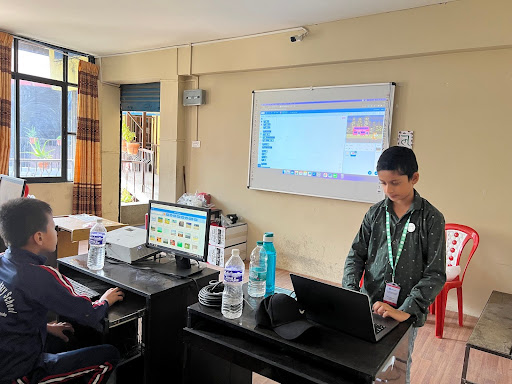
A room with a two boys looking at computer screens.
Young coders in Nepal

Celebrating linguistic diversity

International Mother Language Day celebrates the diversity of languages and cultural identities across the world. At Code Club, we also share a common vision: to give children the opportunity to learn to code, no matter who they are or where they come from.

Did you know?

  1. There are more than 7000 known languages in the world
  2. English is the most widely spoken language globally (approximately 1.45 billion people)
  3. The most widely spoken first language is Mandarin (Standard Chinese) (approximately 940 million people)

I’m Lewis, the Code Club Global Partnerships Manager. Although I’ve primarily lived, learned, and worked in a monolingual environment, where English is the most widely spoken language, I learned a lot about linguistic diversity when I spent time in India. When visiting ancient monuments just outside of Chennai with a friend from New Delhi, I asked if he could translate what our guide was describing, however, my friend shrugged his shoulders and said, “I would love to, but we speak two different languages.” I was fascinated to learn that India has 22 official languages from a total of 121, and 270 ‘mother tongues’.

A man standing in front of the Mahabalipuram
Lewis in Mahabalipuram, India

A global clubs community

At the Raspberry Pi Foundation, we have 52 Global Clubs Partners in 41 countries, each with their own networks of clubs involving thousands of young people and volunteers communicating in lots of languages. We recognise the importance of giving young people opportunities to learn in their first language and so we translate as many of our coding resources as we can.

We are committed to creating inclusive learning experiences for young people, and this commitment is shared by all our partners, who actively work to ensure that everyone feels welcomed and valued. Kaye North, Community and Engagement Manager at Code Club Australia, shares how they celebrate cultural and linguistic diversity through coding projects:

“Australia is a multicultural country that respects and values the diversity of its people. Our First Nations communities are recognised as the oldest living culture in the world and today speak a total of 120 different dialects, and of the 26 million strong population, over 270 different ancestries are recognised… Our co-developed projects, such as Tagai Constellation, support communities to share their mother language with a wider community, and also provide a framework for how each individual community can share their language through code.”

Kaye North, Community and Engagement Manager at Code Club Australia

Digital Future Aotearoa (DFA), a long-standing partner in New Zealand, has been working alongside Ōtautahi kura (kura are state schools where the teaching is in te reo Māori and is based on Māori culture and values) to introduce resources with a special focus on Matariki. Learn more about their latest work in this area:

“In kura this year there has been a strong commitment to learn more about Matariki and to celebrate, reflect, and grow knowledge. It has been amazing to support kura aspirations through DFA’s outreach mahi alongside Te Pā o Rākaihautū, Beckenham Te Kura o Pūroto, and Aidanfield Christian School.”

– Kate, Facilitator at Digital Future Aotearoa

How you can help

At the Raspberry Pi Foundation, we make our free online learning resources on the projects site available to everyone, everywhere, so more young people have the opportunity to explore coding and digital making, wherever they are in the world. Thanks to dedicated translation volunteers, we’ve published over 1700 project translations in more than 30 languages, making our online learning experiences more accessible to young learners worldwide.

“IT is everywhere and becomes more important every day. That’s why it’s good to have the opportunity to learn about it while you’re still young. And therefore, I support the Raspberry Pi Foundation by translating their courses into my mother language, which is Dutch. Because you really can’t expect a 9-year-old to fully understand something when it’s filled with foreign words. As a side effect, I’m learning a lot myself while doing this. So, I consider this a win-win situation.” 

– Jeroen Wernsen, Raspberry Pi Foundation volunteer translator

Being a volunteer translator is highly rewarding. It also helps you to develop lots of different skills and gain new knowledge around translation, localisation, and programming.

If you would like to find out more about translation at the Raspberry Pi Foundation or you would like to contribute to the translation of our learning materials, visit rpf.io/translate or contact us at translation@raspberrypi.org.

Bits and bytes of 2023!

As we code our way through the final moments of 2023, members of the Code Club team take a byte-sized trip down memory lane and share their personal highlights from the year.

The Code Club team wearing silly Christmas hats.

Young people’s voices

Tamasin, Head of Code Club, has loved exploring the impact that being a member of a club has on young people.

“This year we’ve talked to lots of leaders and their club members about their experiences, and launched a research project to find out more about the impact of coming to Code Club. I’ve been blown away by how reflective our young members are and how much they value belonging to a group of like-minded people.

I am so grateful to all our club leaders for providing these experiences that are helping young people to develop a mindset of confidence and enthusiasm for digital technologies.”

Coming together in Cambridge 

Sarah, Code Club Community Manager, reflects on the success of our first-ever Clubs Conference, hosted in Cambridgeshire:

“One of our largest and most exciting events this year took place in March, when 140 volunteers and educators involved in Code Club and CoderDojo came together to learn, create, and connect at the first-ever Clubs Conference in Cambridge!

It was such a pleasure to meet so many members of the community in person. I left the conference completely inspired by their dedication, creativity, and enthusiasm – I can’t wait for the next one!”

The back of a person wearing a T-shirt with a Code Club logo talking to a blonde haired lady.

Community collaboration

Zoe, Programme Coordinator, loves how you always brighten her day. Your openness to answer her questions and share ideas on supporting the next generation of digital makers makes her job a joy! This is what Zoe has taken from the year:

“This year, our Code Club community has shone brightly. We’ve had great moments like chatting with you for our micro-interview blog series, hanging out at our ‘Coffee and conversation’ online meetups, and teaming up to improve our progress charts and resources.

You’re a friendly bunch, and it’s genuinely delightful to hear your stories and celebrate your wins. Thanks for always being open to this and for playing a big part in inspiring future Code Club educators. And don’t worry, I have plans for more stickers in 2024!”

Global coding community

Our global partner network has had an amazing year of growth. Izzy, Global Programme Coordinator, shines a spotlight on some achievements:  

“We welcomed twelve new organisations from eleven countries to our Code Club partner network! From Peru to Nigeria and from Burundi to the Philippines, we’re excited to be working with our new partners to bring Code Club to even more young people around the world.

We also took the opportunity to host a meetup for our partners on the African continent. Ten organisations joined us in Cape Town to share their experiences, learn from each other, and make connections, followed by a chance to attend Coolest Projects South Africa 2023, which the team thoroughly enjoyed!” 

Attendees sanding in a group having their photo taken

Launching new projects 

Pete, Learning Manager on the Raspberry Pi Projects Site, shares his favourite project from 2023:

“The team have done some fantastic work to simplify the language in our projects to make them more accessible and to transition the Python and web paths to use the new Raspberry Pi Code Editor.

If I had to pick a favourite project though, it has to be our ‘Sound level meter’ project in our Intro to micro:bit path. I love the way this project links with the path theme of wellbeing, allowing young people to consider the way sound levels can affect them and others..

I also set up my first Code Club this year AND LOVE IT!”

A laptop and two people holding a micro:bit

Learning together

It’s been a year of workshops at Code Club. Darren, Programme Coordinator (Ireland), reflects on our training offer:

“In 2023, we revamped our community training. Incorporating community feedback, I restructured workshops into two one-hour sessions focusing on programming languages such as Scratch, HTML & CSS, Python, artificial intelligence (AI), and micro:bit. Our goal is to provide accessible learning opportunities for everyone, regardless of where people are on their Code Club journey.

In total, we have run an impressive 41 workshops, which have been attended by 1187 individuals. Personally, meeting everyone at the workshops has been a highlight of my year. I hope I helped everyone gain new skills and confidence that they can take back to their Code Clubs.”

Here’s to another year of coding triumphs, shared learning, and creating vibrant and inspiring spaces for young people to code and grow in. See you all in 2024!