How to begin your Code Club session

Welcome to your Code Club session! The first few minutes of any session are a perfect chance to get everyone settled and ready for some fun. By using a few simple activities, you can create a great atmosphere where every club member feels comfortable and excited to start coding.

To ensure everything runs smoothly and safely, be sure to use a “session checklist” to plan what you need to do before, during, and after each session.

A graphic featuring the 'Code Club' logo and a layout of a leader guide, including sections on accessibility, contents, and a session checklist.

Activities for your first session

Some activities are best for your very first session. These are about setting up a great environment for the rest of your Code Club’s journey.

Work together to create a session routine

Setting up a positive and productive Code Club starts with involving your young creators in making the rules. This is a great icebreaker that gives them a sense of ownership. During this first session, spend about ten minutes asking the kids for their ideas on how the club should run. You can then use our “Club rules” template or let them get creative by drawing their own posters to display the rules. This helps create a fun, safe space where everyone can learn and thrive.
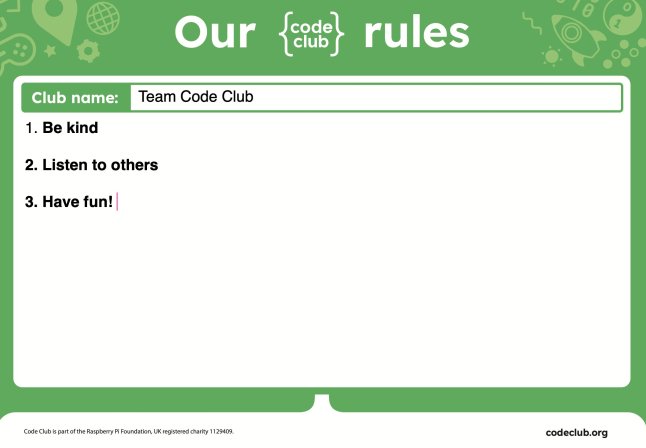
A poster displaying the rules of a Code Club session, highlighting kindness, listening to others, and having fun.

Discuss how to help each other

The best Code Clubs are built on a foundation of mutual support. At the start of a session, take a moment to set some ground rules on how to help each other. Talk about what to do when you get stuck. You can use the motto “Ask three, then me” to encourage young people to try to solve problems on their own before asking a mentor. Also, discuss how to give helpful feedback when testing each other’s projects. This creates a supportive and collaborative environment where everyone can do their best.

Activities for any session

These activities are great for kicking off any regular Code Club session, once you have your initial club rules and routine in place.

Use an icebreaker

An icebreaker is a quick, 15-minute activity. It’s a great way to start your Code Club session, helping everyone get to know each other and switch their focus from other activities. We suggest using an “unplugged” activity” — one that doesn’t require a computer — to help them transition.

A colorful infographic titled 'Introduce a teammate' for a Code Club icebreaker activity, outlining players, resources, and instructions for engaging participants.

Showcase a finished project

If your club is all working on the same project, a great way to start is by showing your creators the finished product they’ll be building. Our projects include a completed example just for this purpose, but you can also show one you made yourself. Seeing the final result gives creators a clear goal and can even spark ideas for how they can make the project their own.
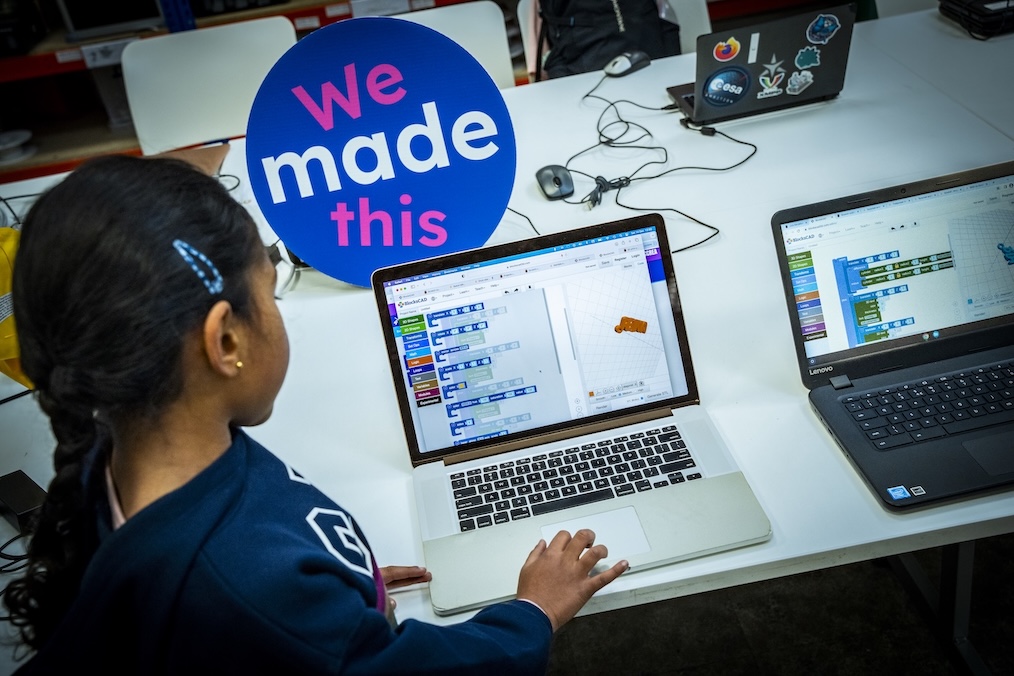
A child engages with a laptop displaying a coding program, while a sign reading 'We made this' is prominently featured in the background.

Demonstrate a tricky section of code

Before the session, look for a part of the project that might be tricky for your creators. Taking a few minutes to show them a new idea — like how to layer code blocks or use a specific function — can be very helpful. This type of short demonstration gives creators the confidence to work more independently.

Explore projects together

Before a session, think about the projects your club will work on. The Code Club projects page has been updated with a fresh, new look and is filled with projects on a variety of topics, like space, art, and games. You can explore these together with your club to find the perfect projects for your group.

Explore the Code Club Leaders’ guide for more tips and information on getting your sessions up and running smoothly. 

A group of young people gather around a table as they work on activity together.

Three icebreaker activities that will build connections within your club

Kickstart your Code Club by using an icebreaker activity! Let us guide you through three icebreakers and how they can help your creators to connect, collaborate, and feel comfortable learning together.

Young people all face the mentor who stands at the front of the classroom
Young people at Linton-on-Ouse Primary School and Nursery getting started at their Code Club.

What is the best way to start your Code Club? There will never be one right answer that will fit everyone: the way you run your sessions will depend on the unique needs of your attendees, their ages, and interests.

But what about those scenarios where you have been thrown a curveball? A new club member is joining, or your creators have all rushed in, and they’re bouncing off the walls! This is where you might want to consider an icebreaker activity.

What is an icebreaker?

An icebreaker is a short activity that takes up to 15 minutes to complete. They can be used at the start of your Code Club session to help everyone get to know each other and warm up. Icebreakers are also a good way to disconnect from whatever activity your creators have come from and turn their focus to Code Club. We recommend choosing an unplugged activity for this.

Let’s explore three icebreaker activities and how they could benefit your Code Club.

New to the club

First up is ‘introduce a teammate’. This icebreaker is excellent for welcoming any newcomers to your Code Club. Led by the creators, it gives them an opportunity to get to know each other in a fun way.

This icebreaker is a low-pressure activity to encourage communication, help new members quickly gain a sense of belonging, and develop public speaking skills, especially in quieter creators. It’s even more of a challenge if creators already know each other: what new facts can they share?

Creating a positive learning environment

Do your creators regularly come charging into the room, buzzing with excitement? Of course they do, and you’re keen to channel this energy into your session, but how do you go about creating a positive learning environment?

The icebreaker ‘robot maze’, works to ease your creators into the session by immediately focusing their energy on an exciting task, as they learn the importance of of being specific when creating their code.

There’s so much flexibility with our icebreaker activities. Why not encourage calm by making this an individual activity. Each creator can try out their instructions on the robot one at a time, getting their brains into gear as they link their learning to the coding project or content you are planning to cover in the session.

Mixing things up

You can use ‘the low-tech social network’ icebreaker to encourage young creators to get to know each other. Creators who regularly attend Code Club may find themselves sitting with the same people at each session.

This icebreaker presents the perfect opportunity to help your creators connect by finding similarities with one another. By encouraging them to chat to lots of different creators, you can build cooperation and teamwork skills to use further down the line.

Check out all of our unplugged activities and try one of these icebreakers in your next Code Club session!

Beyond the classics: exploring Code Club projects in 2025

At the end of 2024, we crunched the numbers and found that classic Code Club projects like ‘Space talk’, ‘Boat race’, and ‘Ghostbusters’ remain popular choices across the world. In 2025, dive into some of our other inspiring projects to help your creators build on their skills!

Two girls sat at a desk with two laptops. The girls are laughing and one girl has her thumbs up.
Make your ideas with Code Club

Exploring new projects and adding your own creative spin can boost learning, spark excitement, and unlock fresh inspiration for you and your creators.

Our projects site offers over 200 coding projects that provide support for creators to learn at their own pace and grow their confidence through hands-on learning. This empowers them to successfully bring their ideas to life through code. Code Club mentor Bob shares how he has used the projects in his club:

“The Code Club projects help motivate creators through the structure. I spend a lot of time at the beginning of a new year with a fresh group of coders showing them the projects and how they work through them, and how they go from one page to the next and find all the hints and tips in the projects.”

– Bob, Code Club mentor

Check out our suggestions and try a new project in your club this year.

Moving on from ‘Space talk’

After Space talk, launch a new space-themed activity with Alien language! Creators will train a machine learning model to recognise alien words and use it to control an alien in Scratch. Get ready for a fun, possibly noisy, introduction to machine learning.

You can expand the project by encouraging your creators to change the sprites and backdrops.

‘Alien language’ Scratch project

From boat racing to scoring goals

Boat race is a Code Club classic, but why not take those coding skills to the next level with a new game? Beat the goalie guides coders to create a two-player game where the aim is to score as many goals as possible in 30 seconds.

Creators can customise the sport, target, and players to make the game their own.

‘Beat the goalie’ Scratch project 

‘Ghostbusters’ is just the beginning

If you love Ghostbusters, try a new challenge with Clone wars. Creators can build on their existing Scratch skills and discover exciting new concepts by creating a game to save the Earth from space monsters — or any other threat that coders can dream up.

‘Clone wars’ Scratch project 

“The Code Club projects start the ball rolling. I often start with the ‘Ghostbusters’ project and very rarely do children make a ghost floating around a manor. They’re picking sprites that relate to things that they’re interested in. Whether it’s about footballs, food, or anything else is what sparks their creativity and inspires them to experiment.”

– Rachel, Code Club mentor, Stevenage, UK

Creators can swap out the extraterrestrial invaders for giant robots, mischievous gremlins, or even a swarm of angry bees. The possibilities are endless!

Explore the Code Club projects, where creators are guided through new coding and design skills to make things that matter to them.