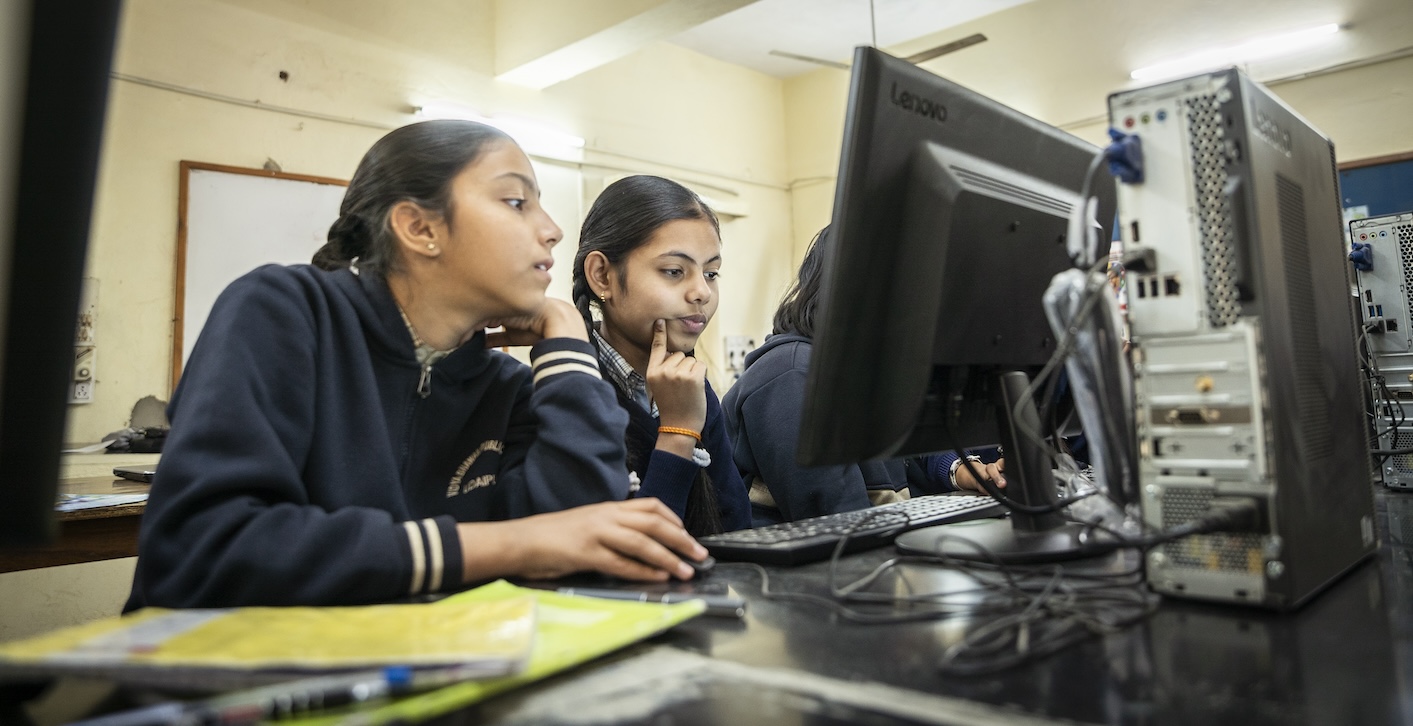
Micro-interview with Code Club creator Jayantika

Jayantika is a 15-year-old Code Club creator from rural Pune, India. This inspiring young coder started as a Code Club creator and is now a peer mentor for other creators in her club.

In this short interview, she talks about her Code Club experience, the positive impact it’s had on her life, and her motivation for supporting other young people in her village to learn to code.

Jayantika supporting creators

Enjoy this micro-interview with Code Club creator Jayantika! 

Let’s get started…

Why did you decide to become a peer mentor?

I’ve been part of my Code Club, run by the BIDKAR FOUNDATION who provide coding opportunities to young people in rural areas of Pune, for the last three years.

Seeing the positive impact coding has had on my life inspired me to support others. So I became a peer mentor to share my coding skills with children in rural areas who have fewer opportunities than those in urban schools.

I believe coding opens doors and helps young children express their creativity. By mentoring, I hope to prepare them for a future that is increasingly driven by AI and technology.

How has being a peer mentor positively impacted you?

I feel more confident — being a peer mentor and teaching others enhances my own understanding of coding. Young people’s positive feedback also boosts my confidence and shows I’m making a meaningful impact through collaborative learning.

It’s also rewarding. It allows me to share my passion for coding, and I can help foster a supportive environment. And I love working with my teammate, Ruturaj, who is my brother. Together, I feel we’re making a difference for the other creators who attend Code Club.

What I love most is seeing children in rural areas grow confident in coding and problem solving. It’s inspiring to watch them transform, knowing they’re gaining skills that can open doors to global opportunities and help bridge the digital divide in their communities.

What advice would you give to someone who wants to become a peer mentor at their Code Club?

I would encourage them to become a Code Club peer mentor because it’s a rewarding experience. Mentoring allows you to share your passion for coding, build your skills, and make a meaningful impact on young learners.

Thank you, Jayantika!

If you enjoyed this micro-interview, check out our others; for example, hear from Terrell in England and learn about how he helps his friends with their coding projects.

Do you want to empower creators like Jayantika? No coding experience is needed to start your own Code Club! Join the movement today.

Micro-interview with Code Club educator Ashwani Tiwari

In our new micro-interview blog series, we chat to educators and young coding enthusiasts about their Code Club experience. Enjoy!

Ashwani Tiwari runs “Maker Lab”, a network of Code Clubs in Udaipur, Rajasthan, India. 

Maker Lab was established in 2022 and partners with government schools in remote tribal areas to create maker labs for coding and tinkering. This network of clubs meets twice a week for one hour, with 1600 students (1200 girls and 400 boys) participating across 12 schools. 

Ashwani Tawari

What inspired you to start a Code Club network across Rajasthan?

I see Code Club as an opportunity to empower young girls who have limited access to technology and are at risk of being forced into early marriage. Code Club enables girls to co-create an excellent career path after schooling.

Can you give me an example of how girls are benefiting from being in your Code Club?

Yes! Harshita, an 11th grader, crafted an automatic river cleaning boat using a text-based coding language, Scratch, and a Raspberry Pi. She showcases how creativity and technology can come together to solve real-world challenges.

Her innovation earned her local acclaim, and secured her seed funding and a pivotal delay in her marriage. Enrolled as the first girl in her village to study science, she symbolises empowerment and the transformative power of education.

In what other ways does participating in a Code Club benefit young people’s future opportunities?

Coding isn’t just about opportunities; it’s a vehicle for empowering young people with problem-solving skills, computational thinking, and entrepreneurial talents. It opens multiple pathways, nurturing creativity and adaptability, preparing them for success in a rapidly evolving digital world, and using technology to change how we learn. 

Six girls behind a table, on the table are flyers and a laptop. Above the table on a washing line are posters.
Young coders from Maker Lab

Why do young people in Rajasthan find Code Club appealing? 

Young people’s attraction to adventure often sparks their interest in coding, as they see it as a tool to solve challenges and pursue careers in aspirational fields like STEM.

Code Club networks offer a sense of belonging and recognition for young coders. Members feel a unique identity and a deeper connection to the coding community. Achieving milestones, like 100 hours of coding experience and the opportunity to mentor others, instils a sense of accomplishment and pride.

Also, coding becomes a problem-solving tool, bridging the gap between ideas and reality, and empowering them to shape the world around them and fulfil their ambitions.

You mentioned learners in your area particularly enjoy solving real-world problems. What types of coding projects are they using to do this?

One example is Manisha, a 15-year-old 10th grader from a remote tribal community, who ingeniously crafted a remote-controlled automatic fertiliser spray machine to aid her father’s farm work in scorching sunlight.

Her innovation has not only eased her father’s workload but has also benefited numerous farmers, inspiring plans for further product development to enhance agricultural efficiency in their community. 

To accomplish this mission, Manisha learnt Scratch, a block-based programming language, and its application with a Raspberry Pi to control the hardware with Virtual Network Computing (VNC). She is also starting on her path to learn the Internet of Things (IoT) to further this project.

What is your vision for the future of Code Clubs in Rajasthan?

This network of Code Clubs embodies a movement for systemic change in STEM education, especially in Rajasthan’s educationally disadvantaged districts. It democratises computing and STEM learning, ensuring equitable access for all. Empowering the next generation with essential digital skills will promote a more inclusive and promising future for all learners.

Thank you, Ashwani!

If you enjoyed this micro-interview, read our micro-interview with Sue and learn about her experiences of using the Code Club resources and projects in her club in the UK

Our Code Clubs are empowering young learners and transforming communities with the help of dedicated volunteers. Are you interested in making a difference and launching your own Code Club in India? Reach out to india@raspberrypi.org 

‘Hello World’: The perfect Python project for your Code Club

Are you ready to introduce your Code Club members to the exciting world of text-based coding? Vasu, our Programme Manager in India, shares her enthusiasm for our ‘Hello World’ Python project. Discover why it’s the perfect starting point for anyone wanting to learn Python and how your young coders can showcase their creations in the 2024 Coolest Projects online showcase.

Vasu waving
Meet Vasu

Hi Vasu! You’ve introduced a lot of young people in India to our projects. Can you share your favourite with us? 

Great question! As someone with no formal coding background, diving into Scratch and Python has been quite a journey. A standout for me is the Python ‘Hello World‘ project. It’s a fantastic starter for anyone — after all, who doesn’t love emojis? 😄

This project is in our Introduction to Python: Variables, functions, and loops path and it serves as an excellent introduction to the Explore projects of 3…2…1…Make! 

‘Hello World’

Who do you think this project is suitable for? 

It’s a great project for all ages! It’s the perfect way to show beginners how approachable Python can be, especially for those nervous about moving on from block-based programming languages, like Scratch. They’ll quickly see it’s not as intimidating as it seems! Go on, give it a go! 

What skills will young people learn from completing ‘Hello World’?  

As Code Club members work through this path, they create an interactive project that uses emojis, they’ll learn how to store text and numbers in variables, and use functions to organise their code. 

What struck me wasn’t just the technical skills gained from working through the project, but the shift in mindset it brought. It’s a confidence booster for beginners, easing anxiety and building the skills to progress on to the other projects in the ‘Introduction to Python’ path. 

A row of young people looking at computer screens in a classroom.
Young coders from Udaipur, India

Do you have any tips for introducing this project into a Code Club session?  

The key tip is ensuring kids have a solid foundation in block-based coding skills before transitioning to text-based programming. Once they’re comfortable with programming basics, help them transition into Python. 

Our ‘Hello World’ project is also one of the projects where we’re trialling the full integration of our new Code Editor! Within the code editor, young people can have the project guide and code in the same window. As we’ve removed the need to switch tabs, learners can focus on coding and having fun! 

How can young people use the ‘Hello World’ project to enter Coolest Projects? 

It is an easy project to start with. Young people can use the skills learnt in this project and upgrade their project with different texts and emojis, or add comments to their code. At the end of the project, young people get some great ideas for upgrading their work. I encourage them to explore these examples and see how they can take their projects further.

Once they’re happy with their project, they can then record a video of their creation and enter Coolest Projects!

Two girls look at a computer screen.
A Code Club in Udaipur

Thanks, Vasu! 

‘Hello World!’ encourages your club members to build their Python programming skills. Why not showcase this achievement and celebrate their work by submitting it to the Coolest Projects showcase?

Young people have until 22 May to submit their creations. If you need further support, check out the resources for mentors webpage. Make sure you share your progress on X using the hashtag #CoolestProjects.