Mentor voices: Chris on empowering independent coders in Minnesota

We’re sharing insights from the incredible mentors who guide and inspire young coders. It’s their unique perspectives and the positive learning environments they foster that truly make these clubs thrive and help our global community grow.

Meet Chris, a passionate mentor involved with Normandale Hills Code Club in Bloomington, Minnesota, who’s building an environment where coders develop their problem-solving skills, normalise failure, and explore their creativity.

A smiling mentor named Chris from the Normandale Hills Code Club in Minnesota, promoting a positive learning environment for young coders.

Let’s kick things off by asking:

What inspired you to become a Code Club mentor?

Volunteering gave me a great excuse to lean into my computer engineering background and do something fun with my kids, who are fifth and third graders. It’s been a blast helping them and all the other kids learn more about computer science while bringing in some real-world perspectives and industry terms (like rubber duck debugging and pair programming).

What makes Code Club projects engaging for the young people in your club?

Our club did a number of simple projects to start using the micro:bits — things like creating a name badge, making pedometers, and playing the ‘Hot Potato’ game — but what really brought out the imagination and creativity of the kids was challenging them to design a game of their own.  

We brought in real-world concepts like project briefs to get them to think critically about what they wanted to build and how they wanted to approach it. Ideas ranged from simplified versions of FIFA and Madden to variations of existing party games.  

There were several moments where you could see it visibly click for one of the kids — when they realised they were not constrained by the step-by-step tutorial into building a specific thing, but had the freedom to create whatever they could dream up… which was quickly followed up by the slight fear in realising the challenge they were in for!

An illustration of a micro:bit surrounded by colorful graphics, including musical notes, party hats, and hearts against an orange background, symbolizing creativity in coding.
Engage young people in physical computing with Code Club projects that explore the BBC micro:bit

How are Code Club projects helping to ignite excitement, creativity, or lively discussion with creators?

It’s fun to see how all the different projects inspire certain kids — some have been more excited by the more visual projects, while others get joy from customising and making a project their own. 

When they were given their first option to build something of their own design, there were LOTS of questions. They ranged from trying to understand the guardrails to questioning how they were ever going to know how to code it.  

Our challenge to them was to just get started! We encouraged the kids to start writing code and test it when it was small, then write a little more and test it a little more. The emphasis was on letting the code come together iteratively, and tackling challenges as they came up instead of trying to anticipate all of them ahead of time.

What impact do you believe Code Club projects have on creators’ understanding of coding concepts?

One of the biggest benefits I see is normalising failure — even if following a tutorial, most kids make at least one mistake the first time doing a coding project. And that’s okay!  

Debugging code is a normal part of the development process, and that makes it safer for the creators to experiment, mess up, and learn along the way. My hope is that the willingness to try (and sometimes fail!) will extend into other parts of their lives and inspire them to take more risks than they may have otherwise.

How does your Code Club empower young coders to develop a sense of independence?

As the club has gone on, our young people have been given projects with less and less guidance, moving on from step-by-step tutorials to projects where they define their own problems. 

We frequently talk about the creative side of coding — how you, the coder, get to decide how to solve a problem. Your code may not look exactly like your neighbour’s. There is no one ‘right’ answer. Giving the kids the freedom to solve the problem in their own way builds a deeper sense of ownership of the solution than having everyone learning to do things exactly the same.  

We also give kids the opportunity to pair and partner with others, and put their collective brainpower to work on tackling a problem. This helps them learn alternative perspectives and broadens their understanding.

Has Chris’ story inspired you to make an impact? Join our community of passionate mentors! With active Code Clubs in over 100 countries, there’s a place for you. Ready to get started? Check out our Mentor at a Code Club page.

National Volunteers’ Week: say hello to our volunteers Jeff and Lisa

This week marks National Volunteers’ Week in the UK, and we are celebrating the 18,000 volunteers across the globe who give their time each week to help inspire the next generation to code.

Allow us to introduce you to two of our volunteers in the UK: Jeff, who has been a Code Club volunteer for six years, and Lisa, who started her Code Club because the children she taught wanted to learn more about coding outside of the classroom.  

Meet Jeff

Jeff is a Code Club volunteer at a Code Club in Salisbury who has been volunteering with us for over six years! Jeff became interested in computers when he himself was a child:

I started my computing journey aged 12, with the home computer revolution of the 1980s. In those days, it was expected that you would write your own programs, and we were enthused by stories of teenagers becoming millionaires after creating popular games!

Jeff had two reasons for deciding to give his time to support Code Club:

I was taking a career break, and Code Club was a way for me to stay in touch with the essentials of my industry, especially as I’d moved away from programming. Also, I’d recently moved to the area, and volunteering was a way to get involved with the local community.

As he is one of our longest-standing volunteers, we asked Jeff what motivates him to keep on supporting Code Club and our vision to give every child the skills, confidence, and opportunity to change their world.

It’s nice to see the children developing their skills and especially to be able to encourage and mentor the ones who really ‘get it’. Our club has been running long enough that we’ve had many children returning year after year, and even some who have followed their older brothers or sisters through the club.

For everyone who has just started on their volunteer journey with Code Club, Jeff has this advice:

Different children enjoy different aspects of the projects, and you need to give them a bit of space to explore this, whilst also keeping them moving ahead on the overall task. We’re not trying to turn them all into programmers but to give them an understanding and a flavour of what programming is.

Say hi to Lisa

Lisa teaches Computing to Year 1–6 students at the Arches Community Primary School in Chester.

A lot of the children Lisa taught wanted to do more coding outside of the classroom. While she attended Picademy, Raspberry Pi’s professional development programme, she found a great way to give her students that opportunity: setting up a Code Club at her school!

At Lisa’s Code Club, three quarters of the participants are girls, and all her learners support each other in the sessions:

I love seeing the relationships the members build. They all go to the same school, but the Code Club members are like a little family. As a volunteer, I love watching their creativity, resilience, and collaboration blossom — all the aspects of computational thinking that underpin everything we do in life.

While volunteering, you sometimes come across club members who are nervous or unsure whether they can code. Lisa gives this advice to all her club members:

We love hearing about the moments when you as volunteers see the difference you are making to young lives. One of Lisa’s favourite moments is this:

I taught a girl in Year 5 who cried every time I said we were going to do coding. She really struggled with the concepts and thought this was because she’s a girl. I reminded her that I am a girl, and I can code. I invited her to Code Club and paired her up with a more confident girl. Now she’s in Year 6 and mentors new starters to our club! She is an incredibly talented programmer and is so creative.

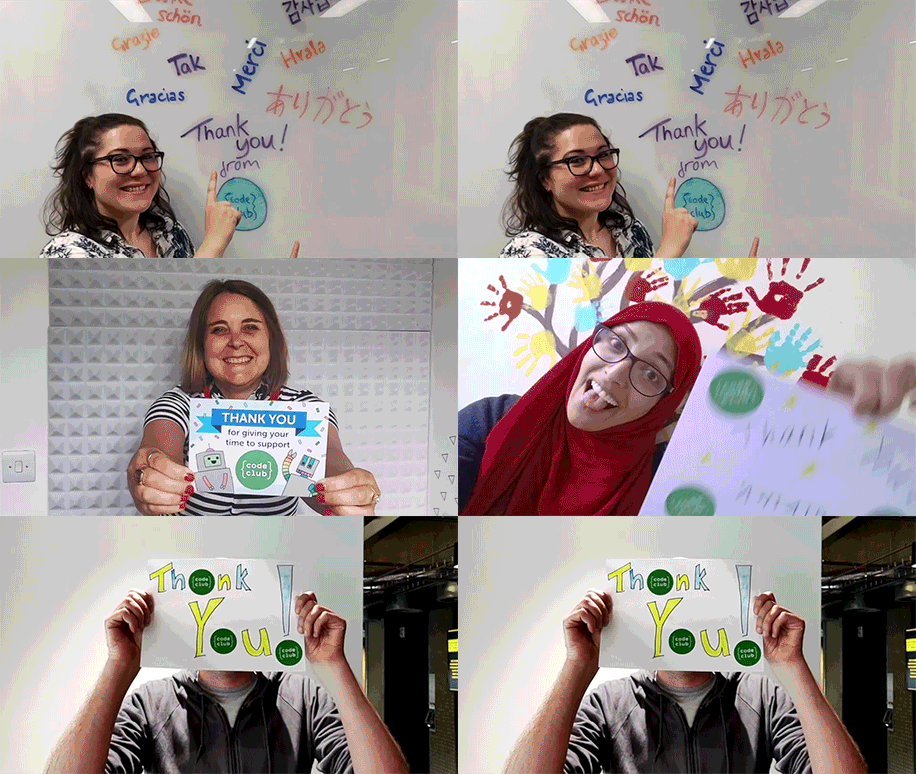
If you are one of the 18,000 people who support Code Club each week, we want to say an enormous THANK YOU to you!

Jeff and Lisa support young learners, and so can you!

Could you give one hour a week to inspire the next generation to code, like Jeff and Lisa do? Then sign up and become a Code Club volunteer today.

Why we volunteer for Code Club

At Code Club we are lucky to have thousands of volunteers who give their valuable time each week to help us on our mission to get young people coding. This National Volunteers’ Week, Caroline Vaan-Canning, our Regional Coordinator for the South West, reflects on what it is that makes people volunteer their time for Code Club.

Time is a funny thing that means different things to different people: numerous physicists and thinkers have attempted to define time, and no single definition is universally accepted.

I have been the Code Club Regional Coordinator for the South West for two years, and in that time, I have had the privilege to meet some of the most wonderful volunteers any charity could hope for. Be they educators, technology professionals, students, or parents, they are all united by their willingness to donate their time in order to support young people learning to code.

Screen Shot 2018-06-06 at 15.03.36

Caroline volunteering at Code Club

Why do these lovely people volunteer for Code Club? I posed that question to four volunteers and received four different, insightful answers.

What motivates our volunteers

Elena from Somerset said she was inspired to volunteer after she saw the impact Code Club was having on her own children. “Code Club is a wonderful way to help children broaden their minds. My children couldn’t get enough of it, and we ended up going to all the sessions available at our local library. As a parent, I have watched my children’s skills grow. That’s the reason I became a volunteer — to help other children’s minds grow too.”

27909384898_e866b060a1_z

Members of Elena’s Code Club recently won the Scratch category at Coolest Projects UK

Meanwhile, KS2 Computer Science educator Neil told me about how being a volunteer has allowed him to develop his own skills. He said: “By running a Code Club, you are not only helping young people to understand the whole coding ethos, but also the way it works in the world around them. As a bonus, we also get to learn with them and have a great time while doing so. You may even get a new career out of it!”

For software engineer and STEM Ambassador Milo, it’s the pure enjoyment of Code Club that keeps him coming back: “Working with children to create fun and imaginative projects is both enjoyable and rewarding. The ideas they come up with often shock me due to their ingenuity and eccentricity.”

volunteers-week

Milo, Elena and Steve at Code Club

Finally, it was a desire to share his love for coding that led software developer Steve to volunteer with Code Club. He said: “For volunteers, Code Club provides the opportunity to share a passion and enthusiasm for coding, and it is very rewarding to see the children develop. For children, Code Club gives them the opportunity to learn a great skill in a fun and engaging manner.”

Why you should volunteer with Code Club

These volunteers and others like them know that life is simply better when you give something back: an hour spent at Code Club doing something to make someone else’s day better, makes your own day better too.

From my own volunteering experience I know that donating time to Code Club can truly make a difference to everyone involved. As a volunteer, the Code Club learning resources help you advance your problem-solving abilities, and encourage you to build your own ideas, no matter what level your coding skills were at before you started. It’s why the Code Club volunteering network continues to grow across the world.

If you are reading this as one of the many wonderful volunteers out there, I just want to say a huge thank you to you for supporting Code Club. If you know someone who would benefit from volunteering with us, please spread the word to them by sharing our website on Twitter and Facebook, or by inviting them to our next meetup.