From Nepal to Uganda and beyond: our global Code Club network

At Code Club, it’s our mission to put a club in every community in the world. Ellie Proffitt, our Global Partnerships Manager, shares more on how we work with like-minded organisations around the globe to help make this goal a reality.

Two people hold the Code Club sign outside of a building
Growth Partner, Generación Tec

How can we help every child around the world access the fantastic opportunity of being in a Code Club? This is a question we think a lot about. Ensuring all children have access to digital making is a global challenge, and we want to be leading the way to find a solution.

We have Code Club colleagues based in the UK, Ireland, India and the United States, but unfortunately, we haven’t figured out a way to clone ourselves so that we can be based in every country in the world — yet!

This is why our partnerships with other organisations are so vital to our mission. We team up with others to help us grow our Code Club community in locations that we would otherwise struggle to reach. Thanks to the work of our partners, there are Code Clubs in rural villages in Malawi, isolated parts of Northern Canada, First Nations communities in Australia, and in thousands of villages, towns, and cities in between.

A map of the world highlighting where partners are
Where are partners are in the world

Our partnership programme

Organisations join our global partner network to work with Code Club and grow our club community in their local area, or even across their entire country. Our partners share our vision to give every child the skills, confidence, and opportunity to change their world, and are committed to helping us achieve this.

In return, we provide them with our free, high-quality resources, including online training, community events, and easy-to-follow projects to support them in their coding journey. We also translate our projects into various languages, so that more people around the world can use them and children get to experience coding without a language barrier.
For many partners, running a Code Club gives them an opportunity to learn to code alongside their young people.

From Kathmandu to Kampala

The organisation Digital & Beyond was already working with schools and educators in Kathmandu, Nepal, to support them with digital literacy. They joined our global partner network as a way to provide more children with the opportunity to learn to code, as most students were not receiving any kind of formal computing education. With support from Code Club, they have been able to set up over 15 clubs in the past 4 months!
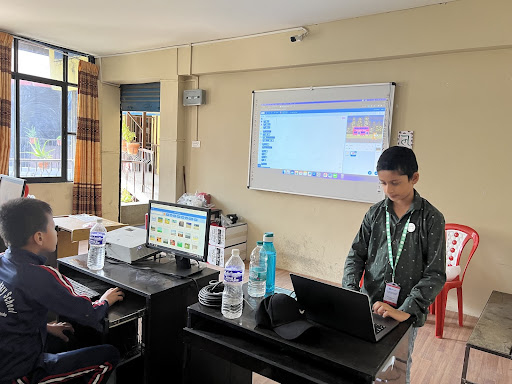
A young coder standing at the front of a classroom sharing his project.
A Code Club member from Nepal shares his project

We applied to partner with Code Club because of our passion for education and wanting to contribute to teaching valuable skills to children, enhance their critical thinking skills, and create a culture of working in teams to solve real-world problems.
To expand the Code Club initiative beyond a single location, the partner network provides guidance and support for scaling up our efforts to reach more students in Nepal.

Sagun Dhungana, CEO of Digital & Beyond

For Silver Bolt, a partner based in Kampala, Uganda, Code Club fits perfectly with their own mission to break down the barriers to computing education. As well as supporting students in schools, Silver Bolt have been working alongside other organisations in their community to encourage more girls to get into computing.

So far, the Code Club partner programme has ignited a passion for coding and technology among young learners in Uganda, opening doors to a world of possibilities.

We recently trained a community-based organisation that empowers underprivileged girls with practical skills. By adding coding to their curriculum, we’ve opened up new horizons for these young learners. Our collaboration with Code Club not only aligns perfectly with our mission but also supplements it by enabling bridging of the digital divides and empowering underprivileged communities.

Maryanne Karamagi, Co-Founder and Managing Director of Silver Bolt

These are just two examples of how our global partnerships are bringing Code Clubs to young people around the world. If you want to see more examples, check out this micro-interview from Solomon and find out why Code Club is forming an essential part of young people’s learning journey in The Gambia.

Could you become a Code Club partner?

Our global partner programme is now open to applications from organisations around the world! If you are part of an organisation that shares our vision and values, and has the ambition and capacity to grow Code Club in your local communities, find out how you can get involved

Micro-interview with Code Club Growth Partner, Solomon

In our new micro-interview blog series, we chat to educators and young coding enthusiasts about their Code Club experience. Enjoy!

Solomon’s organisation, The Unique Foundation, has been a Growth Partner since 2019. He runs a thriving Code Club at his learning and resource centre in The Gambia and describes his club as creative, empowering, and innovative.

The children who attend represent a diverse mix of boys and girls that come from 20 different schools in the area, and Solomon shares why Code Club is an essential part of their learning journey.

The Unique Foundation

Enjoy this micro-interview with Code Club growth partner, Solomon. 

Let’s get started…

What inspired you to become a part of the Code Club network?

We strongly believe in the transformative power of digital skills and their potential to create opportunities for young people. Witnessing the lack of access to computer knowledge among high school graduates in The Gambia and other sub-Saharan African countries inspired us to take action. By bridging the digital skills gap, we aim to empower young individuals to thrive in the 21st century.

How does your Code Club empower young coders to develop a sense of independence?

Our Code Club empowers young coders to develop a strong sense of independence and self-resilience through our focus on developing technical skills. Through hands-on learning and practical experience, our young coders gain confidence in their abilities, foster their problem-solving skills, and develop the resilience necessary to tackle challenges in the rapidly changing digital world. By nurturing their cross-cultural communication and innovation abilities, we empower them to become independent learners.

Why do young people in The Gambia find Code Club appealing?

Code Club is appealing and well-received amongst young people in The Gambia due to its interactive and engaging learning approach, empowering them to be creators and express their creativity through coding. Developing future-ready skills prepares them for opportunities in the digital world, while the sense of community and collaboration fosters peer support. Additionally, Code Club’s international recognition and access to resources enable participants to learn from and collaborate with young coders globally, broadening their horizons.

How can participating in Code Club benefit young people’s future opportunities?

They can expect to develop coding and digital literacy skills that will serve as a strong foundation for higher education in computer science or related fields. Code Club fosters innovation, encouraging young participants to pursue entrepreneurial ventures or contribute to existing companies. Collaboration and networking within the coding community can lead to internships and mentorships, while participation in tech competitions and hackathons provides platforms for recognition and potential job offers. Global exposure opens doors to remote work opportunities and international collaborations, shaping a promising future.

Thank you, Solomon!

If you enjoyed this micro-interview, read our micro-interview with Sue and learn about her experiences of using the Code Club resources and projects in her club, in the UK.

If Solomon’s journey with Code Club has sparked your interest, explore how you can become a Code Club Global Partner!

Set your writer’s side free with National Novel Writing Month!

Join the US team in participating in National Novel Writing Month throughout November and write to your heart’s content!

There’s a million stories inside us, all just waiting to be told. But it’s up to each of us to let them out! You’re not alone in wanting to share your story: this month, something HUGE is taking place in the world of writing — it’s National Novel Writing Month!

Every year, writers and storytellers in the US spend the month of November writing their own stories with the aim of completing a first draft by the end of the month. But writing isn’t the only way to tell a story, so we want to challenge your Code Club members to unleash their storytelling skills and harness their coding skills to create an original story in Scratch!

This challenge presents a brilliant opportunity for young people to explore not only their creative writing skills, but also to develop their critical thinking and problem-solving skills by using Scratch to build interactive stories and animations. It will empower young people to share their thoughts and ideas, and to express what truly excites them.

Get started: Pick a genre and plot

It’s easy to get intimidated by the blank page, especially when you’re trying to come up with an original story on your own, but there are a number of ways to make it easier for your club members to begin this challenge. To start, it might be helpful to have your coders think about what genre they want to explore. Genres can loosely be described as:

  • Fiction – a story where most, if not all of the details, are created from your imagination
  • Nonfiction – a story where all of the details are true, meaning everything actually happened
  • Poetry – a story written in “lines” and “stanzas”, rather than paragraphs, and that can sometimes rhyme
  • Drama – a story that is usually acted out in a play, musical, ballet, etc.

Next, get your students to think about their favorite story; this can help them find inspiration for what type of story they want to tell. And once they feel good about their idea, they can start putting their story together for their coding project!

Write your heart out

Once your club members are happy with their story idea, the next step is to create a Scratch project where they can bring their story to life and share it with others. Check out this project card we’ve made with writing-themed projects to help your coders explore different ways they can code their story. As always with coding, the possibilities are endless! Maybe they’ll want to format their story as a comic or have it acted out on a theater stage with different sprites playing each character.

However they choose to tell their story, we want to see it!

Three projects to help your coders

Check you’ve got the write stuff

This challenge is designed to take place over the course of the entire month of November, so it’s important for your coders to keep track of their progress. We’ve created a checklist to help them make sure their project has all the necessary elements, and when they’re ready to share their tale, your authors can upload their projects to our dedicated storytelling Scratch studio. 

  1. Pick a genre for your story
  2. Brainstorm an original story idea
  3. Come up with an exciting title
  4. Start writing your story
  5. Complete a first draft of your story
  6. Create a Scratch project where you can share your story
  7. Proofread your story and check your code 
  8. Upload your story to our Scratch studio
  9. Share your project on social media using the hashtag #MyCodeClub
  10. You’re done! 

Let your writer’s side shine! 

We have an inkling that this challenge is going to be full of page-turners! We’d love to see how your students get on with this, so make sure to use the hashtag #MyCodeClub to share what your Code Club is working on!